Rithmm: AI Sports Betting
4.3 133.00 Reviews
Analysis By AppCompare
I approached Rithmm: AI Sports Betting as a sports analysis tool rather than a magic answer machine. Its central promise is straightforward: use artificial intelligence to help examine player props and predictions. That focus makes it more specialized than a general score app, and it also means the value depends heavily on how carefully I interpret what it shows. I would recommend it to someone who enjoys researching matchups and wants an organized second opinion, not to someone looking for guaranteed results.
The app comes from Rithmm Inc. and sits in the Sports category. It is free to install, carries a Mature 17+ rating, and has built a modest but meaningful audience, with over one hundred thousand installs and a 4.3 average from around five hundred ratings. Those figures suggest that the concept has found an audience, although they should not be confused with proof that its predictions will work for every user or every betting style.
What the prediction capability actually adds
The most useful way to think about the app is as a filter for decision-making. Instead of opening several sports pages, scanning player statistics, and trying to remember which details matter, I can use a prediction-focused workspace to narrow my attention toward player props and related outcomes. That does not remove the need for judgment; it changes where I spend it.
In my experience, this distinction matters. A prediction can look appealing when viewed alone, but its usefulness depends on context: the opponent, the player’s expected role, recent form, and the line being considered. An AI-based recommendation may help me notice a possibility I would have missed, yet it cannot turn an uncertain sporting event into a certain one. The strongest benefit is therefore structured research, not guaranteed profit.
That makes Rithmm more interesting than a basic scores-and-news application. A conventional sports app is usually best for following games, checking schedules, or reading updates. This one is aimed at the point where a user wants to evaluate a possible player outcome. If that is the part of sports analysis I care about, the narrower purpose is an advantage. If I mainly want live scores or team news, the specialized approach may feel unnecessary.
The app’s store summary describes it as “Player Props & Predictions,” and that accurately sets the expectation. I would not install it expecting a complete replacement for every sports resource on my phone. I would use it as one layer in a research routine, especially when I want help organizing possibilities before making any personal decision.
How I would use it during a normal sports day
A realistic scenario is an evening game that I already plan to watch. Before it begins, I open the app to review the player-prop angle rather than immediately choosing a position. I look at the available prediction context, identify which players or outcomes deserve a closer look, and then compare that impression with what I know from other sources. The app gives me a starting point; it should not be the only thing I consult.
This workflow is more useful than treating every displayed prediction as an instruction. I prefer to create a short list of candidates, then ask why each one looks interesting. Is the player likely to receive enough opportunity? Does the matchup make the outcome plausible? Is the line attractive enough to justify the uncertainty? Even when the app cannot answer every question by itself, it can make those questions easier to ask in the right order.
One practical tip is to separate discovery from commitment. I would first use Rithmm to find potentially notable props, then pause before acting. That pause helps prevent the common mistake of confusing a confident-looking interface with certainty. It also gives me time to check late changes that can affect a player’s role, such as lineup news or unexpected availability information.
Another useful habit is to keep a simple record of my reasoning outside the app. I would note what attracted me to a prediction, what information supported it, and what ultimately happened. This is not a feature claim about the application; it is a way to test whether I am using the tool intelligently. Without that discipline, it is easy to remember the attractive calls and forget the misses.
I would also avoid opening the app only when I already want confirmation. If I have decided that a particular player must perform well, I may unconsciously search for support. A better approach is to review the available possibilities first and then compare them with my own view. That makes the AI output a challenge to my assumptions rather than a justification for them.
The best situation for Rithmm
The app makes the most sense for a sports fan who enjoys player-level analysis but does not want to build every comparison manually. It can be especially useful before a game, when there are several possible props and I need a way to focus my attention. Someone who follows individual athletes closely may appreciate having a prediction-oriented tool alongside a score app, news feed, or statistics site.
It can also suit a cautious learner who wants to understand how prediction-based research fits into a routine. I would start with observation rather than immediately treating the output as a reason to spend money. Watch how the recommendations influence your thinking, compare them with your own research, and decide whether the process genuinely saves time or improves clarity.
The app is less suitable for someone who wants a passive experience. It does not remove the need to understand the sport, follow relevant news, or accept uncertainty. If I only want a quick pick with no explanation or personal evaluation, the experience may be frustrating. Likewise, anyone uncomfortable with betting-related content should note the Mature 17+ rating and the app’s clear focus on sports betting analysis.
There is also a difference between casual sports interest and sustained player-prop interest. A casual fan may enjoy checking a prediction once in a while, but the app’s narrower purpose becomes more valuable when I regularly think about individual player outcomes. For a person who mainly watches team standings, a standard sports companion will probably be a better fit.
Where the convenience ends
The largest trade-off is trust. Artificial intelligence can process patterns and present suggestions in a convenient form, but the presentation can make uncertain information feel more authoritative than it is. I would treat every prediction as an input, not as a verdict. Sports remain affected by injuries, coaching decisions, playing time, game flow, and events that no model can fully anticipate.
There is also a financial consideration. The app is free to install, but it includes in-app purchases ranging from under a dollar to amounts approaching one thousand dollars per item. That wide range makes it important to understand what is included before paying for anything. I would begin with the free experience, identify the actual feature that would improve my routine, and set a firm personal spending limit before considering an upgrade.
That advice is particularly important because a paid prediction tool does not automatically make a betting decision better. If the underlying question is poorly chosen, extra access will not fix it. I would only consider paying when I could explain exactly what problem the purchase solves, such as reducing repetitive research or making a particular workflow easier. Otherwise, the free version is the sensible place to start.
The app’s audience size and rating are encouraging, but they do not replace personal testing. A 4.3 average from around five hundred ratings tells me that many users find value in the experience, while the roughly one hundred thirty written reviews indicate that there is some detailed user feedback to consider. Neither measure can predict whether the interface, prediction style, or purchase structure will suit my habits.
Version 3.4.11 shows that the application is being maintained as a continuing product rather than a one-time release. It first appeared in September 2022, and its minimum requirement of Android 7.0 makes it accessible to many older Android devices. Still, compatibility alone says nothing about whether the experience will feel equally comfortable on every phone. I would pay attention to readability and navigation on my own device before building a daily routine around it.
Another trade-off is the risk of narrowing my attention too much. Player props can be engaging because they turn a game into a collection of individual questions, but that can distract from the broader sport. I would use the app alongside normal viewing and team context rather than allowing a single player outcome to become the only reason I watch.
How it compares with familiar alternatives
Compared with a standard sports-score app, Rithmm is more analytical and less general-purpose. A score app is usually faster for checking what happened, while this tool is more relevant when I am thinking about what might happen to a player. I would keep both types available if I followed sports closely: one for live awareness and one for focused prediction research.
Compared with manually searching statistics, the app’s appeal is convenience. Manual research can be more transparent because I know exactly which sources and numbers I am using, but it also takes time and can become inconsistent. Rithmm may help me form a shortlist more efficiently, while independent research remains important for checking whether that shortlist makes sense.
Compared with informal picks from social media, an app built around predictions feels more organized. Social posts can provide ideas, but they may be shaped by personality, excitement, or selective memory. Rithmm is preferable when I want a repeatable starting point. Even so, I would not assume that an organized presentation is automatically more accurate than a careful human analysis.
Compared with a spreadsheet or personal tracking system, the app is easier for someone who does not want to build a process from scratch. A spreadsheet offers control and a clear record of past decisions, but it requires effort and maintenance. The best choice depends on whether I value immediate convenience or complete ownership of the method. For me, Rithmm works best between those extremes: faster than starting from nothing, but still requiring personal review.
Who gets the most from the app
I see the strongest fit among users who already follow player roles, understand that props depend on opportunity, and want help prioritizing research. The app can make a busy pre-game routine more manageable by directing attention toward predictions instead of leaving me to browse without a plan. It is also useful for people willing to record outcomes and judge the process over time rather than celebrating one successful call.
Beginners can use it, but I would encourage them to learn the limits first. A new user may assume that an AI label means the recommendation is objective or certain. The healthier approach is to ask what would make the prediction wrong and whether the potential downside is acceptable. That mindset protects the user from turning convenience into overconfidence.
I would skip it if my main goal were free live scores, team news, fantasy management, or a broad sports portal. Those needs call for a wider tool. I would also skip it if I knew I was likely to chase losses or make impulsive decisions when a prediction looked persuasive. No interface can compensate for an unhealthy relationship with betting.
For responsible use, I would decide my limits before opening the app, avoid treating predictions as income, and never spend more because an earlier result went badly. The presence of high-priced in-app items makes that boundary especially important. The app can support analysis, but the responsibility for any decision remains with me.
My recommendation after using its core idea
Rithmm: AI Sports Betting is worth trying when the specific appeal is player props and prediction support. I like the way its focused purpose can turn a vague pre-game search into a more deliberate review. Its best contribution is not telling me what will happen; it is helping me decide which questions deserve attention.
I would keep expectations realistic. The app cannot eliminate uncertainty, and its recommendations should be checked against current sports information and my own understanding. The free entry point makes experimentation straightforward, while the in-app purchase range means I would be careful before paying for expanded access.
My final view is positive but measured: this is a useful companion for an engaged sports fan, not a substitute for judgment or a promise of results. If you enjoy studying player outcomes and want an AI-assisted starting point, Rithmm: AI Sports Betting can earn a place in your routine. If you want a simple scoreboard, guaranteed picks, or a completely hands-off betting experience, I would choose a different kind of app.
FAQ
What is Rithmm: AI Sports Betting and how does it work?
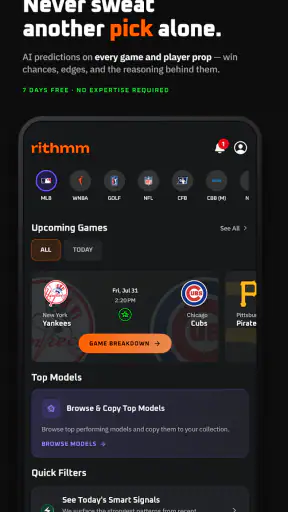
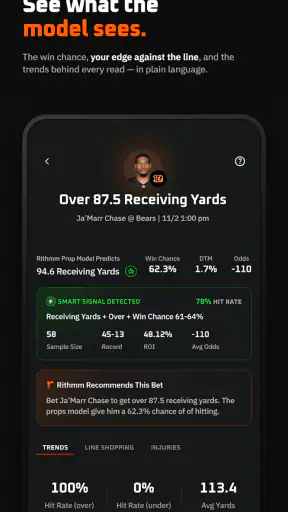
Rithmm is a sports betting analysis app that uses data models, statistics, and artificial intelligence to generate predictions and betting insights. After selecting a sport, league, or matchup, users can review projected outcomes, probabilities, trends, and suggested bets. It is designed to support research and decision-making, not to guarantee winning results or replace responsible personal judgment.
Which sports and betting markets are supported in Rithmm?
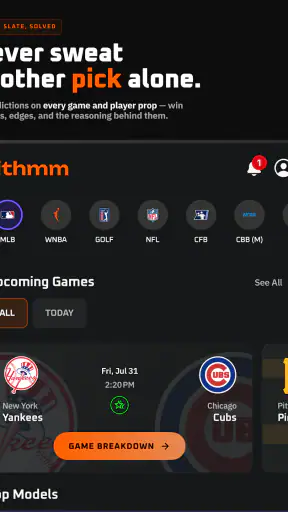
The available sports and markets can vary depending on your location, season, and the app’s current coverage. Rithmm commonly focuses on major American sports and may provide analysis for moneylines, spreads, totals, player props, and other markets where data is available. Before downloading, check the current app listing and in-app coverage because supported leagues and features may change over time.
Does Rithmm guarantee winning bets or provide risk-free picks?
No sports betting app can guarantee profits, and Rithmm should not be treated as a risk-free betting service. Its recommendations are based on statistical models and historical or current data, which can be affected by injuries, lineup changes, weather, market movement, and unexpected events. Use the app as an analytical tool, compare its information with your own research, and only wager money you can afford to lose.
Is Rithmm free to download, or does it require a subscription?
Rithmm may be available to download at no initial cost, but some advanced predictions, model details, alerts, tools, or betting recommendations may require a paid subscription or in-app purchase. Pricing, trial periods, and included features can differ between Android and iOS and may also change over time. Review the store page and subscription terms carefully before starting a trial or entering payment information.
Is Rithmm legal and available everywhere?
Rithmm’s availability and usefulness depend on your country, state, or region. The app may provide sports analysis in places where sports betting is restricted, but that does not mean wagering is legally permitted there. Rithmm generally does not replace a licensed sportsbook, and users must verify local laws, age requirements, and operator regulations before placing any bet. Always gamble responsibly and use authorized services only.
Pros
- AI-generated betting insights cover multiple major sports.
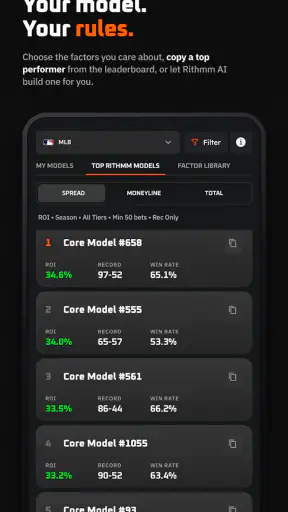
- Personalized picks help users focus on selected teams and leagues.
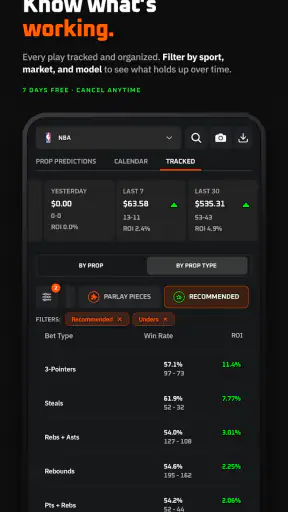
- Displays supporting statistics behind many recommended wagers.
- Clean interface makes daily predictions easy to browse.
- Useful for comparing model opinions across different bet types.
Cons
- Predictions are not guarantees and can still produce losing bets.
- Some advanced features may require a paid subscription.
- Coverage and pick quality can vary by sport and betting market.
- Requires responsible bankroll management to avoid impulsive wagering.
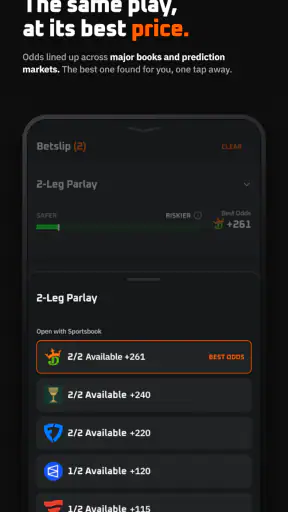
- Odds may differ from those available with your preferred sportsbook.